
TESU Celebrates NJDOE Partnership Expanding College Credit Pathways for CTE Students
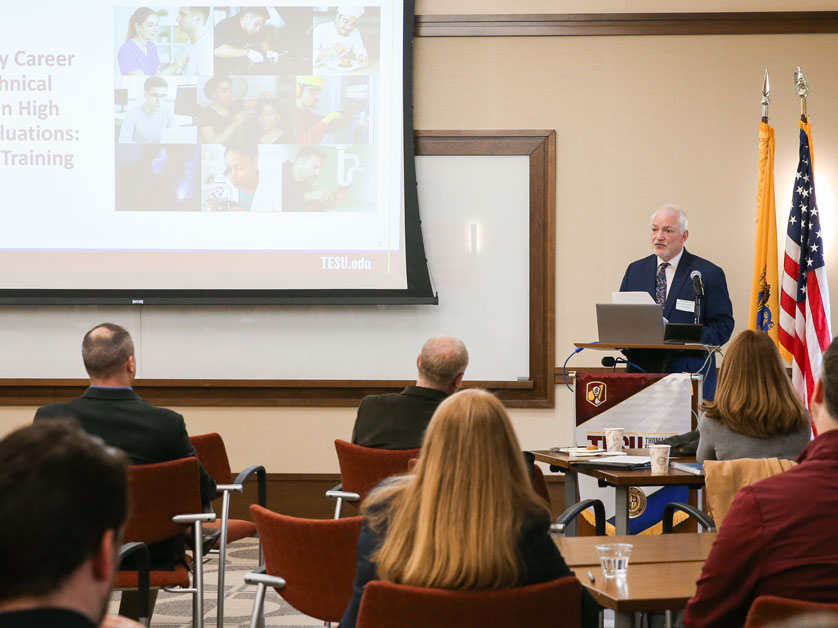
Thomas Edison State University (TESU) today celebrated the completion of a landmark Memorandum of Understanding (MOU) with the New Jersey Department of Education (NJDOE) that expands college credit opportunities for high school Career and Technical Education (CTE) students across the state.
Funded through $250,000 in Federal Perkins Leadership Funds, the 2025 MOU supported TESU’s evaluation of secondary CTE programs for college credit using the University’s nationally recognized Professional Learning Review (PLR) process. The initiative recognizes college-level learning achieved through CTE coursework, workplace training and industry-recognized credentials, creating new pathways from high school to higher education and career advancement.
The event today marked both the completion of the pilot phase and the formal launch of a dedicated website outlining how additional CTE schools can partner with TESU and participate in the initiative. University and state leaders also outlined next steps to expand the program statewide.
“Thomas Edison State University was founded on the principle that learning should be recognized wherever and however it occurs,” said Merodie A. Hancock, Ph.D., president of TESU. “Through our partnership with the New Jersey Department of Education, we are affirming the rigor and value of Career and Technical Education programs and creating clear, affordable pathways for students to translate their high school achievements into college credit and advanced credentials. This initiative strengthens New Jersey’s workforce while expanding opportunity for students and families across the state.”
Central to the initiative is TESU’s PLR process, which evaluates nontraditional learning experiences and determines appropriate college credit equivalencies. By awarding academic credit for approved CTE programs, participating schools can enhance their program value, support postsecondary transitions and strengthen eligibility for additional Perkins funding.
“By bridging the gap between high school and postsecondary education, we are expanding pathways for CTE program completers to enter the workforce with advanced credentials,” said Jeffrey Harmon, Ed.D., vice provost for Strategic Initiatives and Institutional Effectiveness and interim dean of the Heavin School of Social Sciences, Humanities, and Education at TESU. “This latest initiative with the NJDOE leverages our expertise in fostering workforce readiness by recognizing college-level learning wherever and however it occurs.”
The pilot program supports the expansion of TESU’s PLR evaluations, outreach to school districts and curriculum framework development to ensure alignment with industry standards and employer needs.
The impact of similar models is already evident. In 2023, TESU launched a partnership with the United Brotherhood of Carpenters and Joiners of America’s Career Connections Certificate program, enabling New Jersey high school students to earn up to 16 college credits from pre-apprenticeship training toward a TESU degree — potentially saving families up to $7,000 in tuition.
Students utilizing these credit pathways often pursue an Associate in Applied Science in Construction and Facilities Support, a Bachelor of Science in Construction, or a Bachelor of Science in Technical Studies at TESU.
“The MOU is part of a broader effort between the University and the State of New Jersey to strengthen the state’s workforce by equipping students with the skills and credentials necessary to succeed in a competitive job market,” Harmon added. “Our mutual work centers on enhancing the career readiness of New Jersey’s workforce while ensuring our program outcomes are aligned with employers’ current and anticipated needs.”
Speakers at the event included Harmon, Hancock and Jorden Schiff, Ed.D., assistant commissioner for Teaching and Learning Services, New Jersey Department of Education.
“This partnership marks a momentous step forward for Career and Technical Education students across New Jersey,” Schiff told the gathered crowd. “By recognizing college‑level learning through TESU’s Professional Learning Review process, we are opening doors to anywhere from six to 40 college credits, giving students a powerful head start on their higher‑education and career journeys.”
With the pilot phase complete and the website now live, TESU and NJDOE leaders emphasized their shared commitment to expanding participation and ensuring that more CTE students across New Jersey can seamlessly transition from high school programs to college degrees and career advancement.